Nocturnal
By Spencer Connor
The nocturnal is a fairly simple instrument for measuring time at night, by holding it up and moving the various pieces to align with the northern constellations. Throughout the night the constellations wheel overhead, spinning about the north pole (very near the star Polaris) once per sidereal day. By measuring where a given constellation is, the sidereal time can be measured very simply. However, while sidereal time is useful for astronomers it is less so to everyone else. At a given sidereal time the same constellations will be in the same place, but that will be during the day for some of the year and night for the rest of it, because the sun is moving through the constellations throughout the year. So a 365 day year actually has 366 sidereal days, and a sidereal day is 1/365th shorter (or 23:56:04 hours, rather than 24:00:00). The nocturnal compensates for this difference by having a disk that counter-rotates throughout the year, and therefore provides the much more useful mean time as a clock would. Since the stars are being used as reference the nocturnal is theoretically far more accurate than a sundial (and avoids complication from the Equation of Time), but as a handheld device it is limited by the user trying to hold it steady and straight while sighting two lines of sight simultaneously so expect errors on the order of 15 minutes.
The Parts
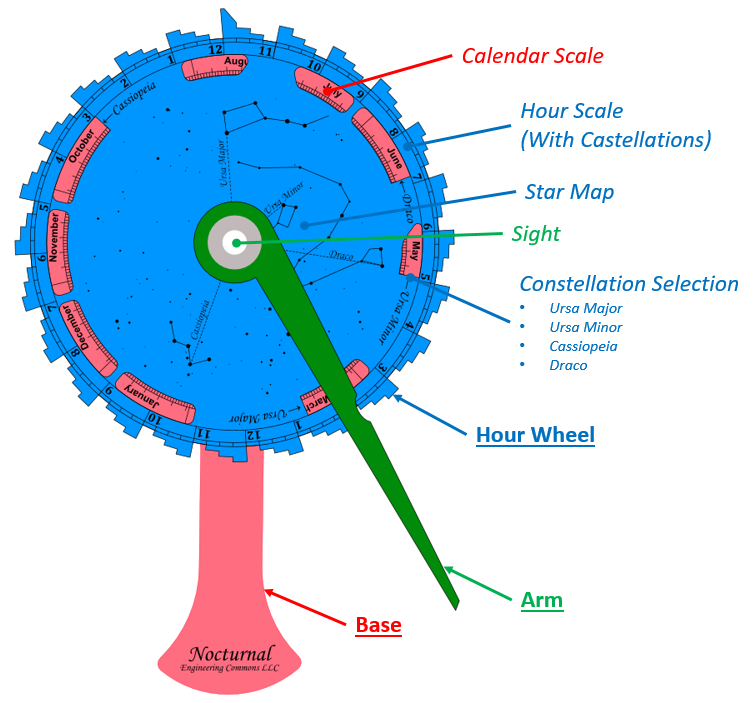
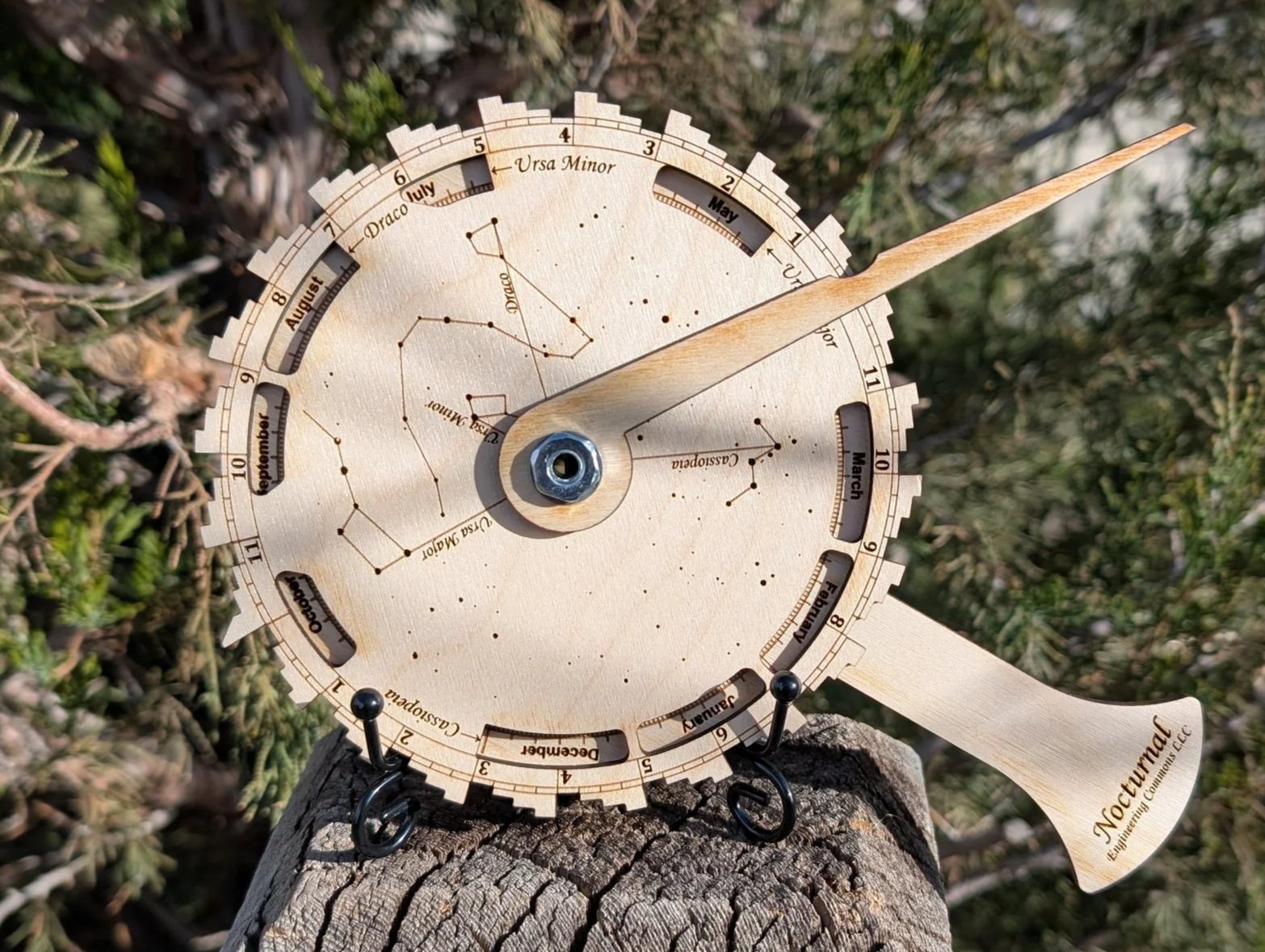
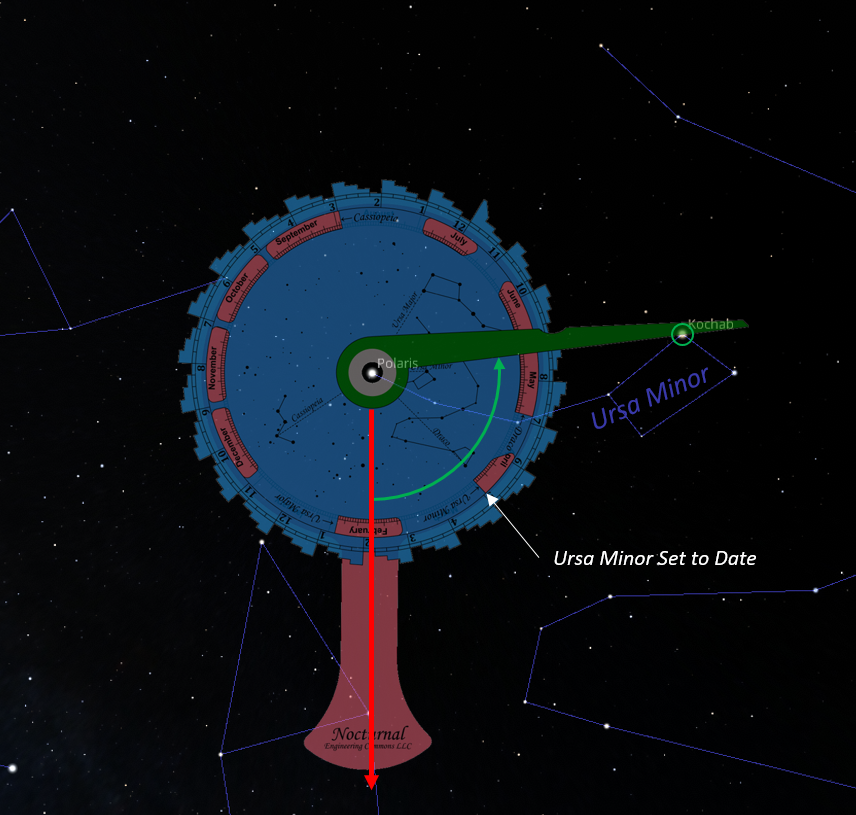
The Nocturnal consists of three physical parts, each with multiple markings. All three parts are free to rotate relative to one another, and around a common central pivot that is hollow such that the user can sight through it. The base is the lowest piece and includes a handle to hold and provide an orientation reference. It has a calendar scale on it running counter-clockwise. The hour wheel is the middle piece, and has specific constellation references marked on it. In my design, these are edges of windows that align with the calendar scale below. Nocturnals almost always have Ursa Major, often Ursa Minor, occasionally Cassiopeia, and my design includes Draco. In fact, it is a specific star within each constellation that is used in practice: Dubhe (Ursa Minor), Kochab (Ursa Minor), Schedar (Cassiopeia), and Eltanin (Draco). While not traditional, I’ve added a star map to my design to keep track of where to look. The hour wheel features a 24 hour scale around the perimeter, which is often castellated or notched so that the user can count by feel how many hours from midnight (usually uniquely shaped) in the darkness. The final piece on top is the arm, which has no scales but simply extends beyond the others.
Usage
Setting the Date
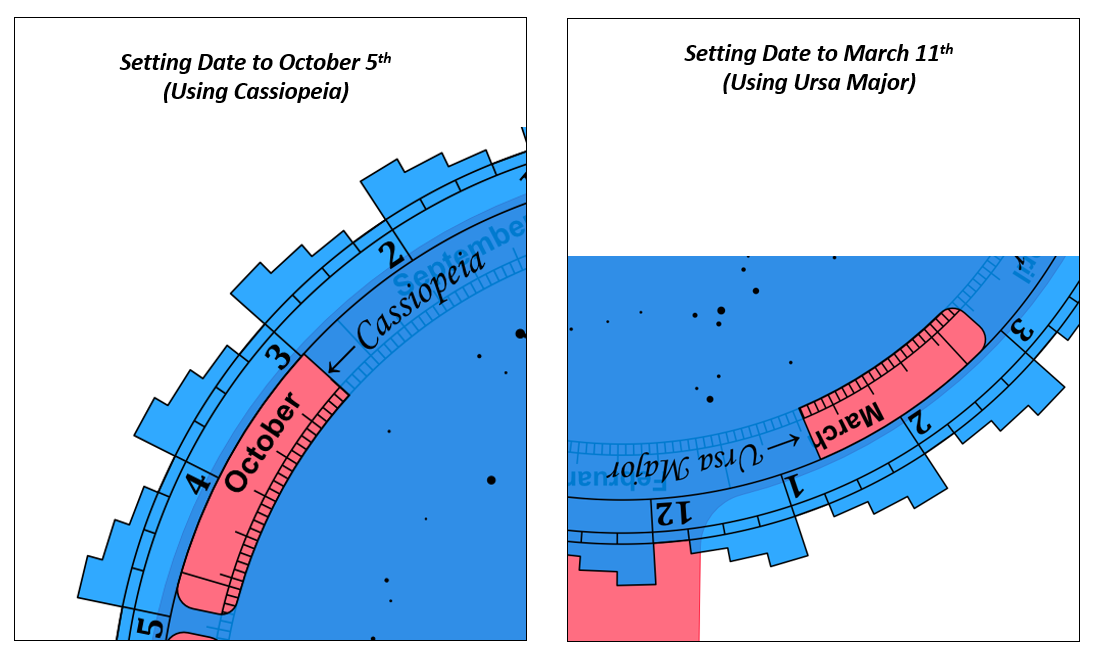
To set the date, the user must first choose which constellation will be used. This is often based on which is most visible at the time, often the one highest overhead has the fewest obstructions but clouds may force a lower constellation to be used. The nocturnal may still be used if all but one of the references constellations are obscured, but Polaris MUST be visible for it to work. Once the constellation is selected, the hour wheel is rotated so that that constellation indicator aligns with the current date. From then on the hour wheel is held together with the base.
Sighting with the Nocturnal
The user faces north and holds the nocturnal up in front of them, with the handle facing straight downwards. Looking through the central hole in the pivot, the user moves the nocturnal (while still keeping it vertical) until they can see Polaris through it. Then, without moving anything else, they rotate the arm until it aligns with the bright star of the selected constellation. It can be difficult to do at first, do not be discouraged!
Some tips:
Make sure your eyes are well acclimated to the dark and avoid bright lights. It can take more than 15 minutes for your night vision to recover from bright headlights
Be sure that you are only using the same eye for sighting Polaris through the pivot as sighting the other star with the arm
Bracing against a tree or structure helps tremendously to keep things steady and the handle vertical
If you’re having trouble finding Polaris in the small hole in the pivot, put it right up to your face to find. Then slowly back it away while keeping it visible through the hole.
Reading the Time
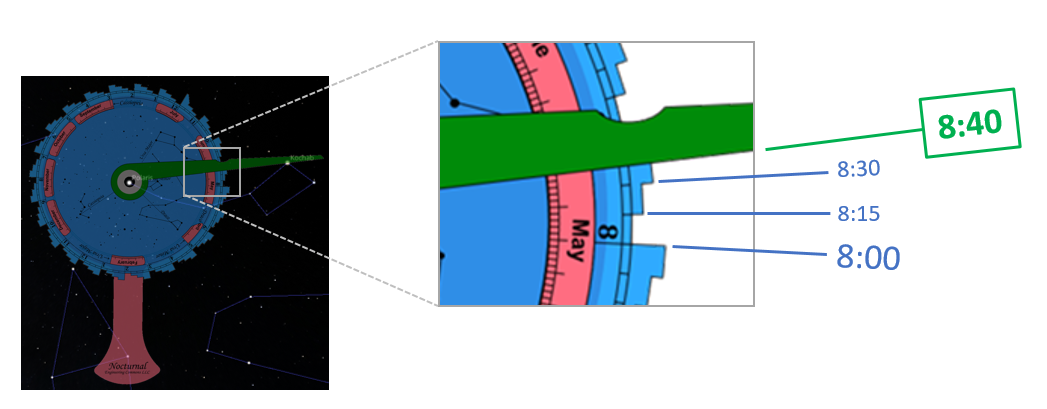
Following sighting, the time can either be felt (by locating the midnight spike on the hour wheel and counting the hour spikes from it to the arm) or looked at with some light (but be careful not to blind yourself and lose your night vision lest you need to try again!). On the Engineering Commons design, each spike is an hour and it is further divided into 15 minute steps.