Lunar Volvelle
By Spencer Connor
The volvelle is potentially the oldest form of analog computer and in its most basic form consists only of a few pieces of paper tied together with some string, which functions as a rudimentary pivot. A proper volvelle has at least two rotating parts on a stationary one, but some extravagant volvelles may include a dozen or more. The fundamental principle they operate on is that if you know some value B relative to A and C relative to B, you know C relative to A. In many ways akin to a slide rule, they work particular well with angles since their form addresses unwrapping (e.g. 190° + 200° would compute to 390°, but is functionally 30°). A Lunar Volvelle is a common design consisting of a fixed base (representing the stationary stars), a rotating solar pointer (representing the sun’s position), and a rotating lunar pointer (representing the moon’s position).
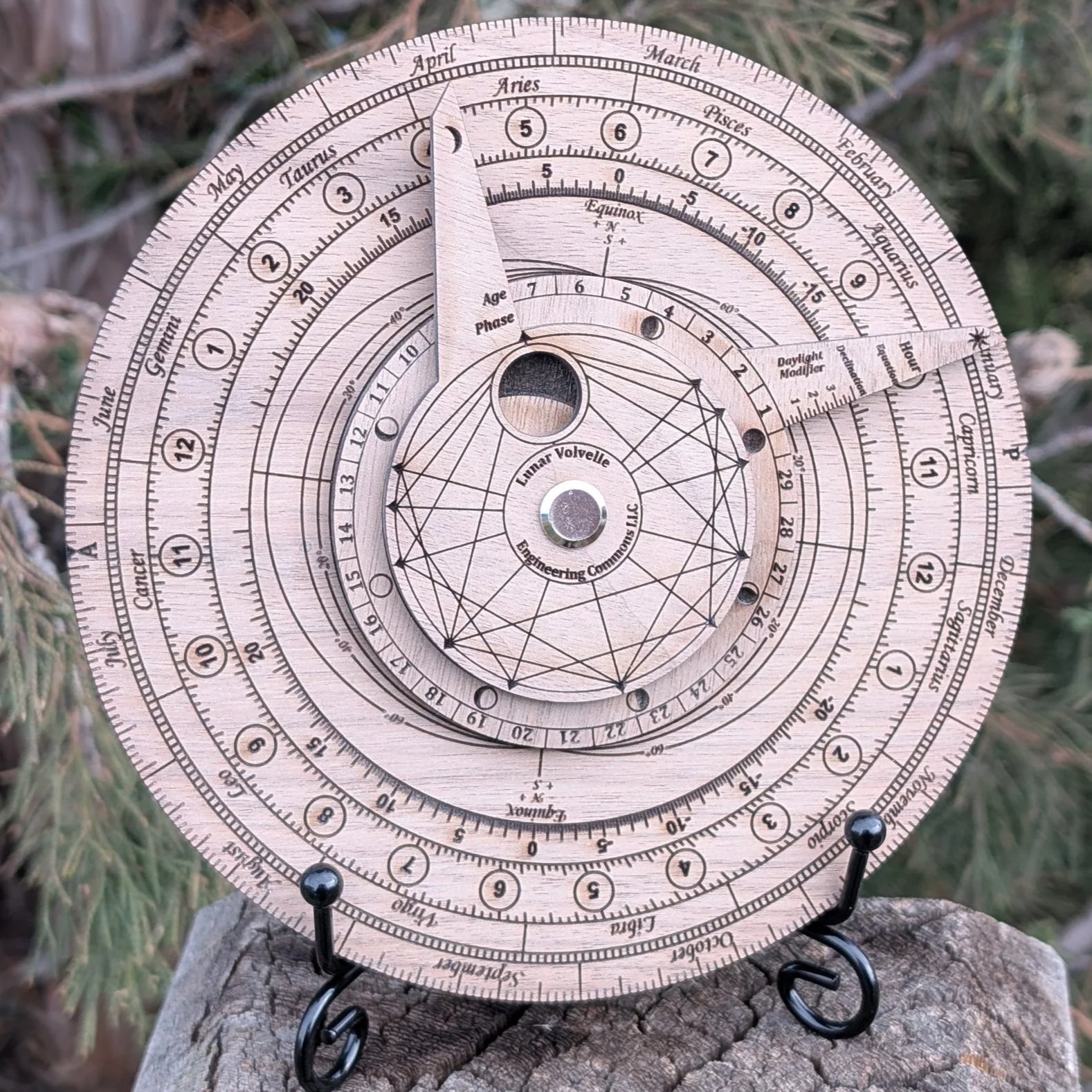
They can have a range of features, and we’ve packed as many as we could fit in the Engineering Commons Lunar Volvelle, so while we’ll be explaining that specific design below there will be overlap with other designs as well.
The Parts
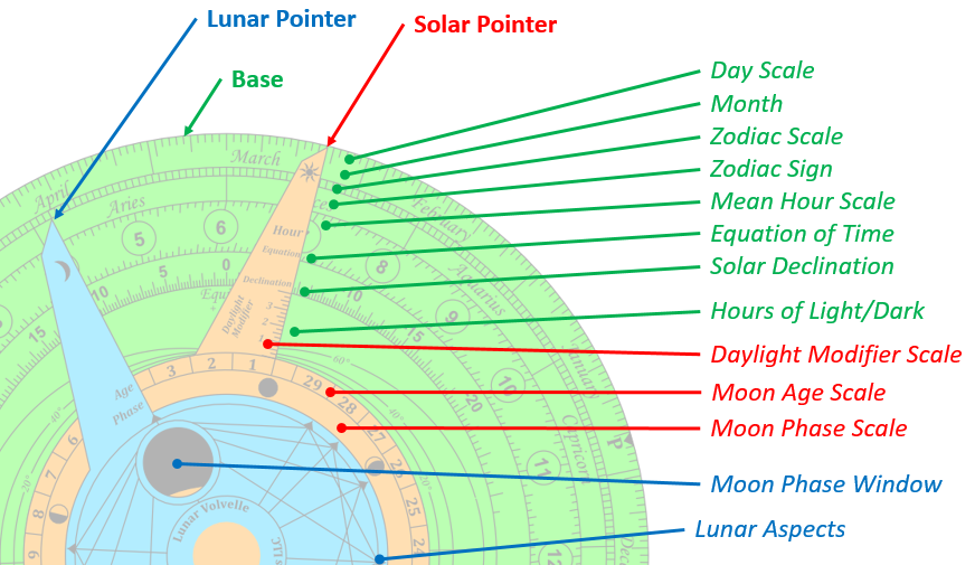
The Lunar Volvelle consists of three physical parts, each with multiple markings. All three parts are free to rotate relative to one another. The base is the lowest piece with the most scales and represents a fixed reference. The middle piece with the longer arm is the solar pointer, and represents the position of the sun. It can be set by rotating it until the arm is aligned with a specific value on one of the base scales (such as the date). The top piece with the shorter arm is the lunar pointer and represents the position of the moon. As its arm extends over both the solar pointer and the base it can be set and read relative to a scale on either one (e.g. the moon age or the zodiac scale).
Functions
Setting the Date
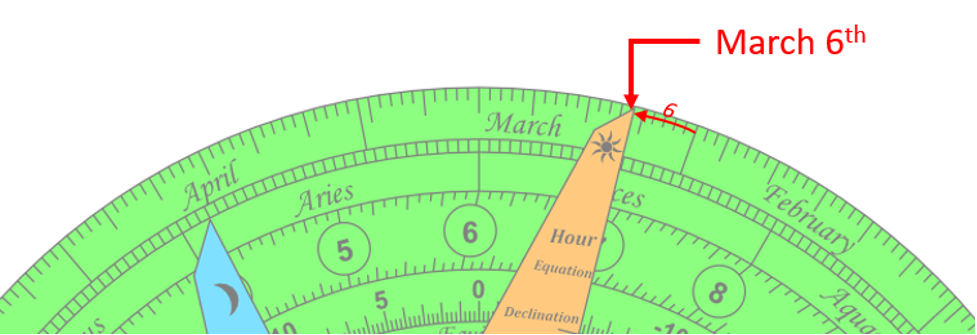
The most basic input for the lunar volvelle is setting the date, which is done by rotating the solar pointer until the tip aligns with the desired month and day of the month on the outermost scale (e.g. March 9th in the figure below). The passage of a year corresponds to a full counter-clockwise rotation at a uniform speed, while each tick mark corresponds to one day (with the longer ticks being every 5 days). Setting the date is a prerequisite to many following functions.
Reading Solar Position
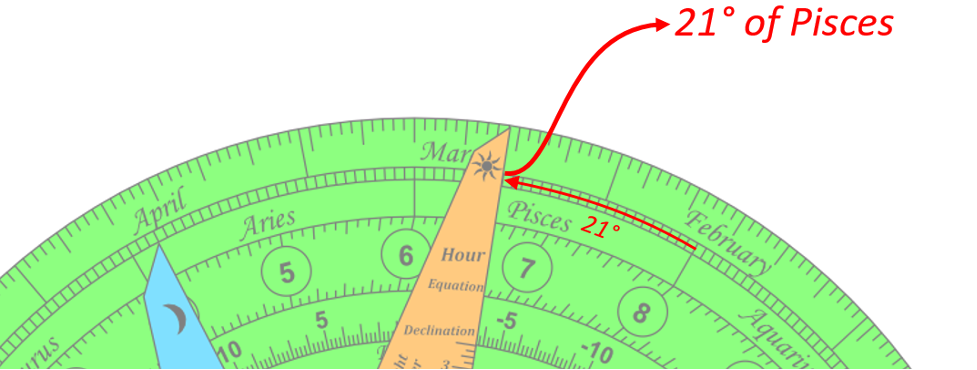
After setting the date, the rightmost edge of the solar pointer will align with the zodiac position of the sun on that date. The sun travels along a functionally fixed line in the sky (the ecliptic), which is split into 12 equally sized sections, or zodiac signs, of 30 degrees each starting at the ascending intersection of the ecliptic with the equator. This point is known as the First Point of Aries, and is the start of the first sign (Aries) as well as the reference for modern astronomical coordinate systems like J2000 and JNow. Since the signs are geometrically equal, but the speed at which the Earth orbits is uneven (due to orbital eccentricity), they appear slightly unequally spaced on the volvelle. In other words, because the earth is traveling faster at perihelion (denoted with a P in the date scale) the zodiacal scale appears slightly more compressed on that side of the volvelle.
Reading Solar Declination
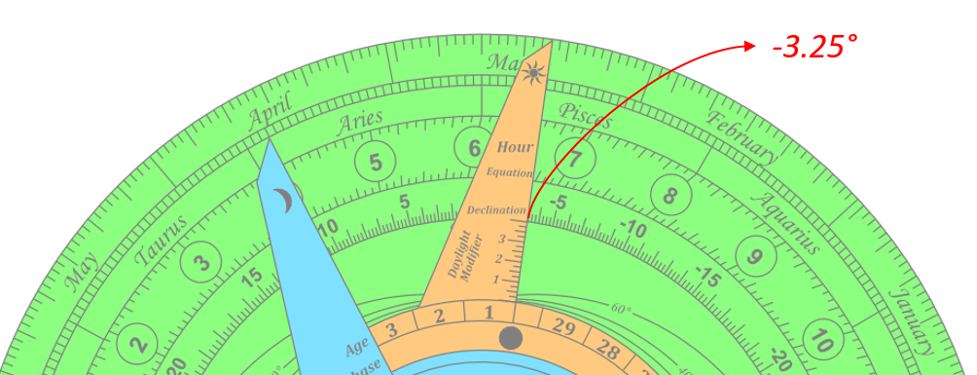
After setting the date, the solar declination can also be read. This is again read from the solar pointer, but off the declination scale. As the sun travels on the inclined plane of the ecliptic, it spends about half the year above the equator and the remainder below. At the First Point of Aries (vernal equinox), the declination is zero and increases to 23.5° at the summer solstice, then decreases back to zero (autumnal equinox) down to -23.5° on the winter solstice, before returning to zero again. Similar to zodiacal position, the eccentricity of the earth causes the scale to compress slightly on the perihelion side of the volvelle.
Determining Solar Culmination
Solar culmination (also known as southing) is the maximum elevation of the sun throughout the day, and occurs at solar noon and when the sun is due south (in the northern hemisphere, due north in the southern hemisphere). It is simply calculated as the latitude plus the solar declination. For example, solar culmination for an observer at latitude 60° North will be 36.5° in December and 83.5° in July. On the equinoxes, solar culmination is equal to the latitude.
Reading the Equation of Time
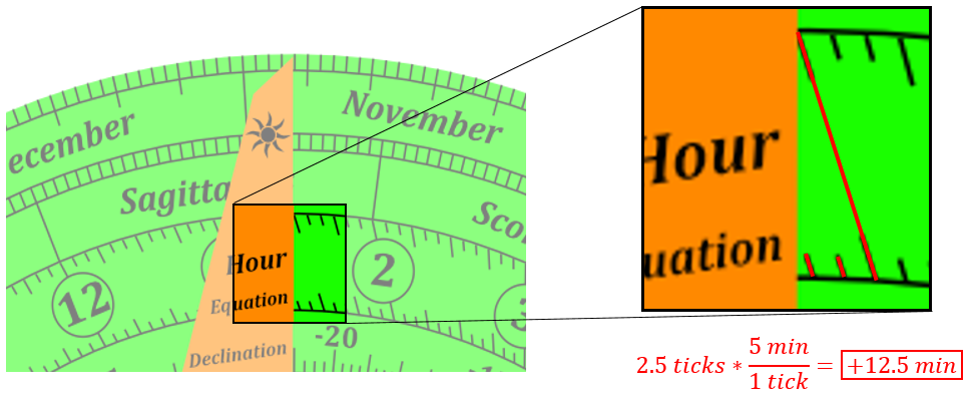
The equation of time is the difference between solar time and mean time, and follows a largely fixed function throughout the year. It can be used as a correction between clock time and solar phenomenon such as sunrise/sunset and solar noon. On this volvelle it is read off of the hour scale, which has two sets of tick marks that appear to slant. The outer set corresponds to mean time, and is equally spaced around the volvelle. The inner set corresponds to solar time, and is offset by the equation of time at that time of year per the date scale. When the ticks appear radially aligned the equation of time is zero, where they appear highly slanted the effect is great and the direction of the slant indicates the polarity. In the image below, we see that for the date of November 26th there is a pronounced slant where the time on the outer dial (mean time) reads 2:30 but the time on the inner dial (solar time) reads ~2:42. Solar time is 12.5 minutes ahead of mean time at this date, so the equation of time is +12.5 minutes.
Reading Time of Sunrise/Sunset and Hours of Light/Dark
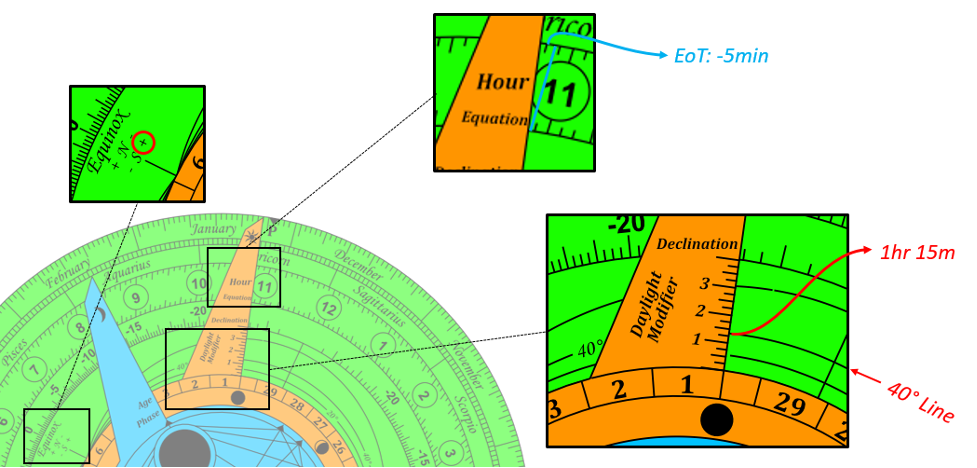
After setting the date, the times of sunrise and sunset can be read and by extension the hours of light and dark for that time of year. This function is performed by the Daylight Modifier scale on the innermost section of the solar pointer. There are three curves in the base for this section, denoted 20°, 40°, and 60°, which correspond to latitudes both north and south. In the image below, a latitude of 40° south is assumed so the 40° line is used. At the set date (January 5th), this line appears to read 1 and an additional tick. The numbers are hours and each tick 15 minutes, so this reads as 1 hour and 15 minutes. Referencing the marker near the equinox label, we see that for a southern latitude the effect is positive, so +1:15 in this case. Sunrise will occur 1:15 earlier than 6am, or 4:45am. Sunset will occur 1:15 later, or 7:15pm. As a result, daylight is 12+1:15+1:15 or 14hr30m long and darkness is 12-1:15-1:15 or 9hr30m long.
Note that an additional refinement can also be done at the same time with the equation of time. We can read that solar time is one tick (or 5 minutes) behind mean time, thus sunrise is closer to 4:50 and sunset 7:20. The result is generally accurate to within 5-10 minutes, but note that it will be affected by your longitude and horizon topography as well.
Setting the Moon By Moon Age
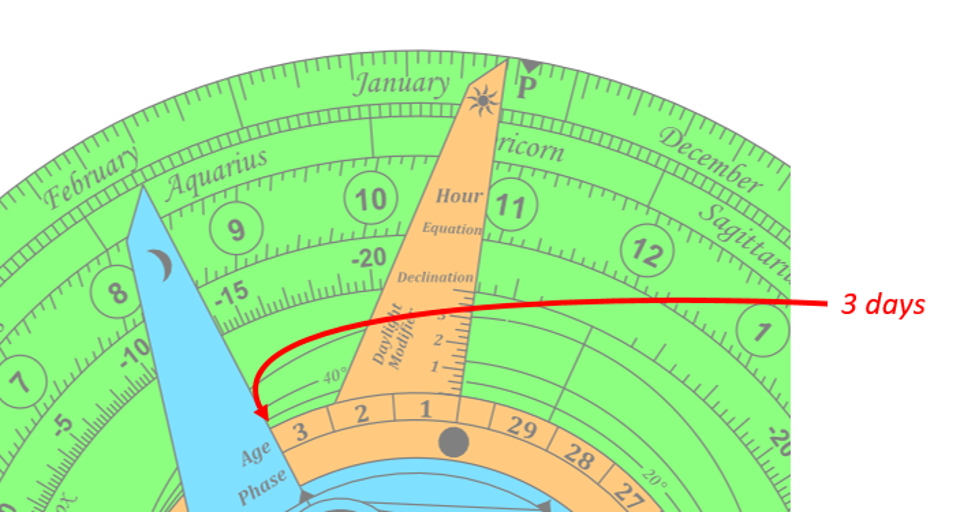
To set the position of the moon, one option is to set the age of the moon. This is simply the number of days since the new moon and goes from 0 to ~29.5, when the next new moon occurs. The moon age scale is the outermost scale on the solar pointer, and the moon age is set by rotating the lunar pointer on it to the desired value.
Note that this scale assumes a uniform orbital motion for the moon that is appropriate for most calculations, but has an error of more than ±6° due to various lunar anomalies. So do not be surprised if moonrise is a half hour early or late!
Setting the Moon By Moon Phase
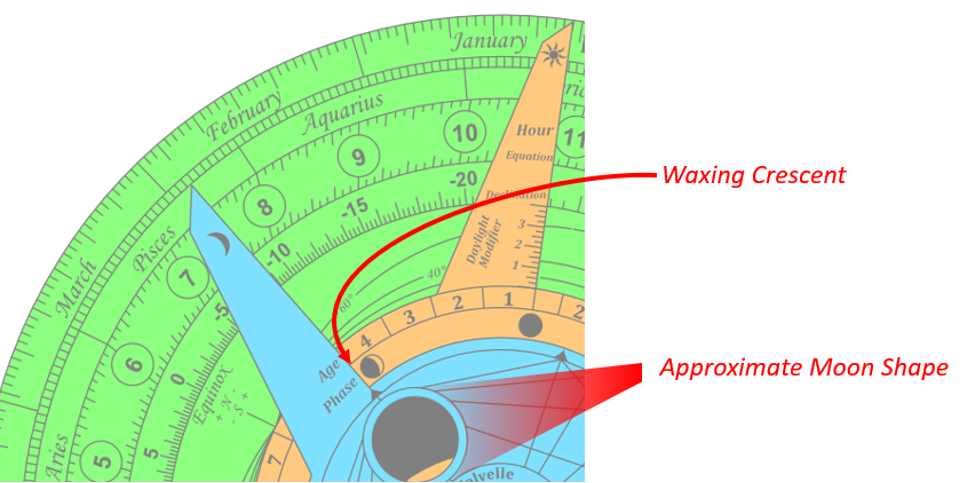
The other option to set the moon position relative to the sun is the moon phase. This can be done with either the moon phase scale (second scale in on the solar pointer,) or with the moon phase window in the lunar pointer. The moon phase window gives only the approximate percentage of illumination so if possible the scale is better to use. It is actually more accurate than lunar age since it more directly uses the solar elongation, but is less precise since the user is left mentally interpolating between the symbols.
Reading the Moon Position
The moon position is read on the zodiac scale just like the solar position, just using the lunar pointer.
Note that lunar anomalies will be causing an error of more than ±6°, but this is still acceptable to determine the moon’s general location.

Reading Lunar Declination
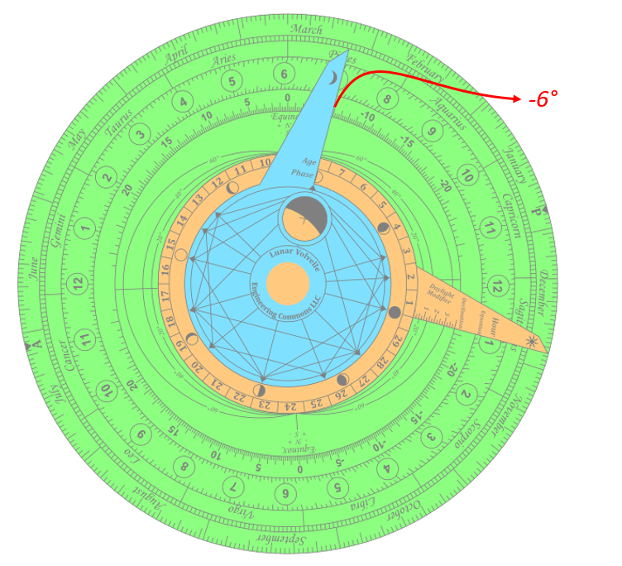
Just like solar declination, lunar declination can be read off of the declination scale except using the lunar pointer. In the figure below, for a 1st Quarter moon on December 4th the lunar declination is about -6°. This can be added to the latitude similar to solar culmination to determine the maximum height of the moon in the sky.
Note: This calculation is approximate to about ±5° since the moon’s orbit is actually slightly inclined relative to the ecliptic plane.
Solar-Lunar Hours
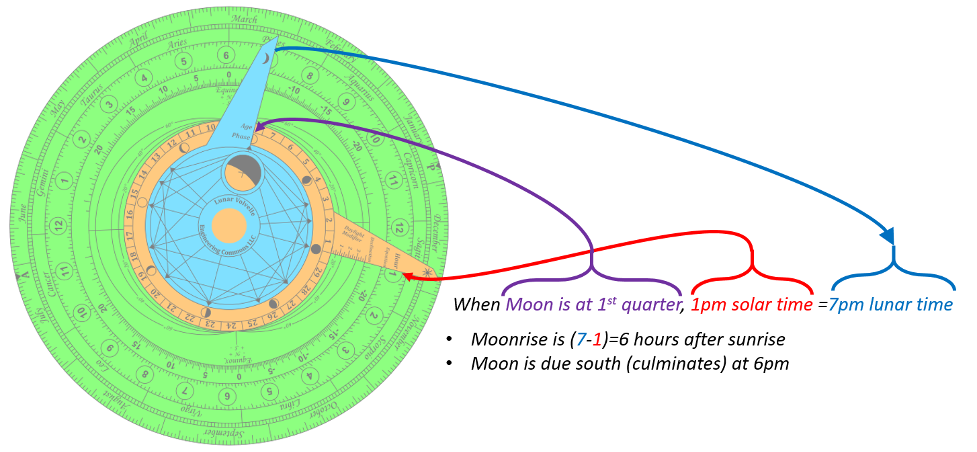
We’ve mentioned solar time, which is based off of solar noon, but there is also lunar time based off of lunar noon. At lunar noon, the moon is due south (in the northern hemisphere) or north (in the southern hemisphere) and at its maximum elevation. Lunar time isn’t particularly useful itself, but combining with moon phase it can be used to find solar time at night.
Telling Solar Time by Moonlight
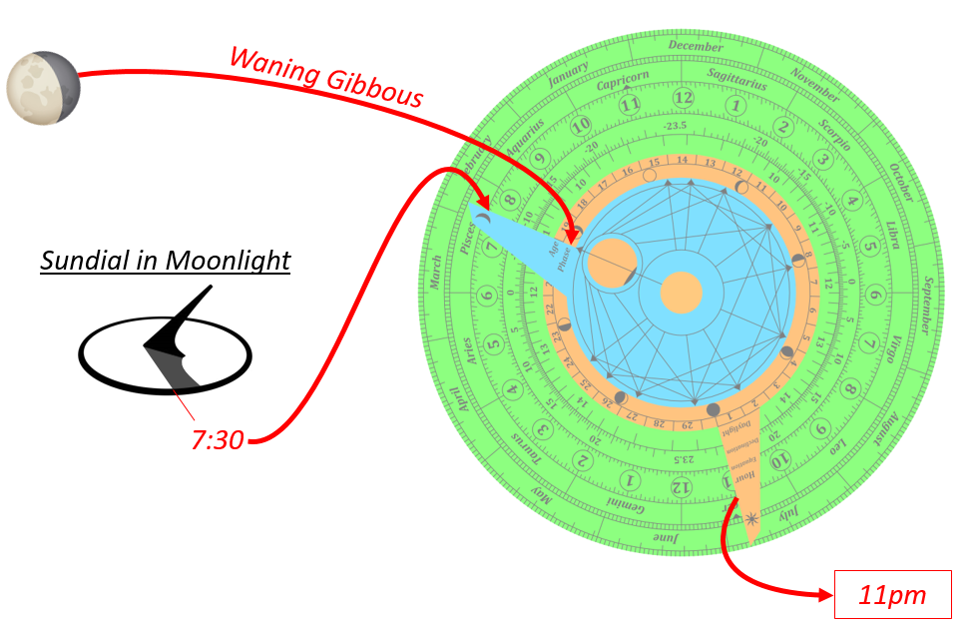
A little known use of a sundial is actually as a moon dial at night using moonlight. Particularly in the full and gibbous phases the moon provides plenty of light to cast a shadow. The volvelle allows this to be translated to solar time. In the example below, a waning gibbous moon is casting a shadow on a sundial that reads 7:30. On the volvelle, we rotate the lunar pointer on the solar pointer to match this moon phase. We then rotate the lunar and solar pointers together until the lunar pointer indicates 7:30. The solar time is then indicated by the solar pointer, in this case 11pm.